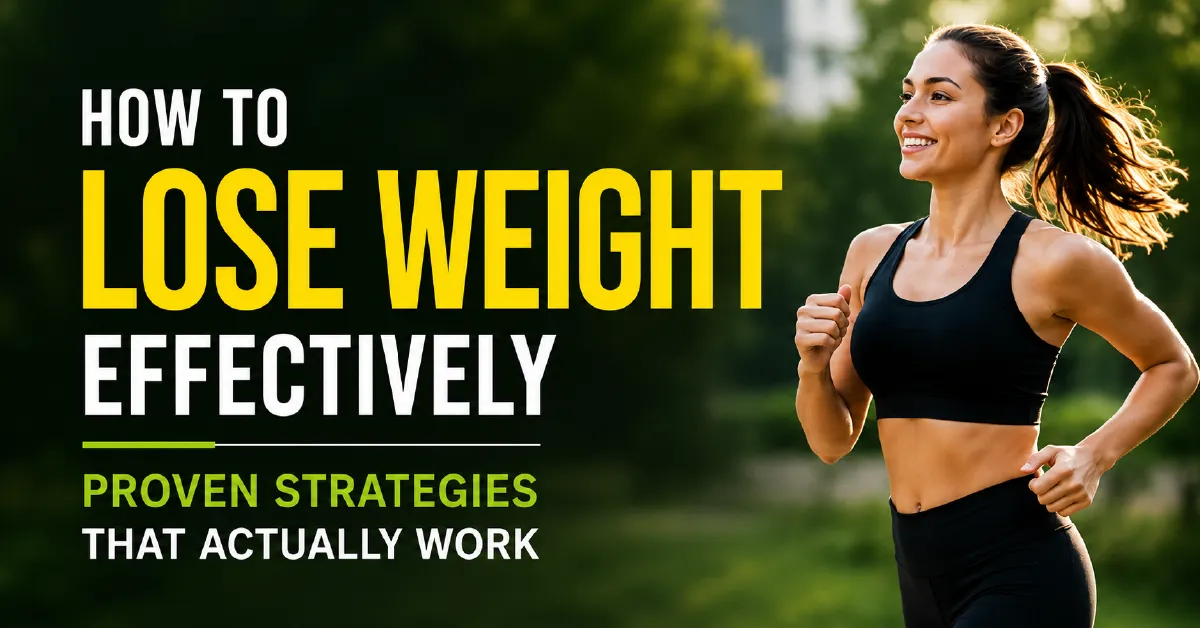
The general rule behind weight loss is easy to understand: to cut down extra pounds, you have to expend more caloric energy than you consume. Though it may sound simple, achieving a fit and lean body still seems like a dream for many, which is why they wonder, ‘how to lose weight’. Though there are several fad diets that assure dramatic weight loss, they will lead to quick weight gain, as they are not created with effective strategies that help manage and maintain a long-term healthy weight. Most of these diet plans falter as they don’t address those changes that don’t suit your lifestyle or preferences. Implementing simple weight loss strategies on an everyday basis will help with your fitness journey as they will transform into good habits. Incorporating tiny and consistent changes that can be followed for a lifetime will help achieve long-term weight loss. Whether you are starting a weight loss journey or trying to cut through a plateau, these evidence-backed strategies will help reach your health goals quickly.
Why Is Quick Weight Loss Harmful?
When thinking about how to lose weight, it is natural to have the urge to shed pounds within a short time. Most individuals want to lose weight quickly. But when speaking about long-term outcomes, you might have to slow down the pace of weight loss. Switching to rigorous weight loss plans might offer impressive results for a couple of weeks but will make it exhausting to stay on track without falling behind. Following sustainable approaches will create better results that will last longer. The general recommendation to lose weight is around 2 pounds every week. Though it might not create a huge difference, it will make visible changes in your body and enhance your health after 3 months. Fast weight loss will lead to serious risks like:
- Loss of muscle
- Low energy levels
- Extreme fatigue
- Vitamin and mineral deficiencies
- Rise in cravings
- Recurrent weight gain
Though you might be happy to see the scale figures going down after quitting sugar, carbs, and processed foods rich in sodium, the change is induced by water weight. So, there will be no reduction in body fat. Weight loss is influenced by major factors like diet, physical activity, hormone levels, age, medical issues, body composition, and weight.
Effective Strategies to Lose Weight
Still wondering how to lose weight? Keep reading to understand how staying committed and maintaining a healthy lifestyle will help you successfully lose weight.
-
Get Set Ready
Losing weight is not an overnight process. It requires you to stay strong, maintain an active lifestyle, and follow a healthy diet to achieve long-term weight loss. You must get ready by finding answers to some important questions to stay committed until you achieve the desired weight and maintain it later.
- Are you willing to change eating habits to achieve weight loss?
- Will you give in to peer pressure or get distracted by junk foods easily?
- Do you rely on comfort foods to deal with stress?
- Are you keen to find new ways to cope with stress?
- Do you need extra support from family, friends, or medical professionals for stress management?
- Are you willing to alter your lifestyle habits to make positive changes?
- Can you spend enough time on your exercise and workout routine?
- Are you willing to stay patient and consistent with efforts even if weight loss progress is slow in the beginning?
If you are able to offer affirmative answers to most of these questions, then you are ready to lose weight with sustainable efforts.
-
Find Your Driving Force
Rather than thinking of how to lose weight, start making subtle changes to your physical activity hours and diet plan as the first step towards weight loss. Create a list that explains why you are keen to lose weight. This list will help you stay focused, motivated, and inspired. The reason behind weight loss might differ from one individual to another – getting back in new clothes for your dream vacation or improving overall health. Think of these goals when you are not in the mood to work out or crave fatty foods. You can create several motivating and inspirational notes on the walls of places like your study room, living room, or balcony where you will spend more time. Have a support group with a handful of friends or family who would understand if you are upset, feel happy for even little progress, and will not mock you for it.
-
Set Small Achievable Goals
Set your focus to lose up to 1 Kg per week to lose weight and stay fit in the long run[1]. To achieve it each week, ensure your body burns between 500 and 750 calories, which is more than the calories you eat every day. If you manage to lose up to 5% of your body weight, it is a good sign to proceed[2]. If your body weight is about 80 Kgs, then losing 4 Kgs will be a good start. Such gradual weight loss will put you at a lower risk of being prone to chronic conditions like cardiovascular diseases and diabetes.
The discussion on how to lose weight is never complete unless you set small and easy-to-achieve goals:
- Actionable Goals: You must set this goal by focusing on specific actions that will help with weight loss. For example, ‘Go for a walk for half an hour’.
- Outcome Goals: This goal should have a healthy outcome that you wish to achieve. For instance, the outcome goal can be losing 4 kgs this week.
Of these two goals, your action goals can be achieved by making subtle lifestyle changes, and it will help achieve outcome goals.
-
Include Simple and Healthy Meals
When thinking about how to lose weight, ensure your food and drinks contain low calories[3]. You can make simple and healthy meals that require less time to prepare. To make your meal contain fewer calories and more fibre[4], add plant-based foods like vegetables, whole grains and fruits. These plant-based foods can keep you feeling fuller and reach your health goals quickly. You can also try these diet variations:
- Consume at least 3 servings of fruits and 4 servings of vegetables per day. You can also try eating vegetables and fruits as snacks when you are feeling hungry in between meals[5].
- Include whole grains like whole wheat, barley and brown rice in the form of rotis, pasta or bread. Limit the consumption of white bread and white rice. But remember to maintain portion control to prevent weight gain[6].
- Cook with healthy fats like ghee, nut oils, nut butters, avocados, and olive oil. But use them in moderation, as excess usage will add up calories.
- Avoid foods high in sugar like sodas, jellies, and ice creams. You can have fresh fruit juice and slurries made with just fruits[7].
- Don’t forget to drink enough water to maintain hydration levels in your body to lower the risk of chronic health issues[8].
- Switch to low-fat dairy products like paneer, milk, curd, and butter.
- Eating foods high in fibre will prevent overeating and promote fullness to avoid cravings[9].
- Foods rich in protein will preserve muscle mass, support weight loss, and promote satiety[10].
-
Stay Active and Keep Moving
When thinking about how to lose weight, it is essential to understand you cannot shed pounds unless you move your body to burn excess fat. Engaging in physical activity regularly will prevent weight gain and support calorie expenditure. Studies reveal that people involved in long-term physical activity can keep off the weight gain and maintain their weight loss results[11]. The number of calories your body burns depends on how hard and how long you work out every day. You can practice brisk walking or aerobic workouts for half an hour every day to burn calories and keep excess weight away. You can also try to incorporate smart ways to help your body burn more calories and promote NEAT, or non-exercise activity thermogenesis.
- Instead of using elevators, choose the stairs
- Park your vehicle far from the place of shopping to walk a few extra steps
- Do tasks like calling someone on the phone or replying to mail while standing instead of sitting
- While watching TV or your favourite sport, try to walk around the room instead of using the couch
-
Manage Stress
Though stress management might feel like an impossible task, regulating your cortisol or stress hormone levels and keeping it under control is easier. High cortisol will impact your weight loss efforts as it can affect your blood sugar levels. Doing Pilates, mindful eating[12] and sleeping well will contribute to healthy cortisol levels. Not maintaining the right sleep schedule can cause imbalances in stress hormone levels[13]. However, ensure you don’t go overboard with calorie restriction and too much workouts, as it may elevate cortisol levels.
Wrapping Up
Trying to lose those extra kilos can be stressful and overwhelming. If you wish to lose weight healthily, seek professional support from Kolors Healthcare to get evidence-based, science-backed guidance customized based on your fitness goals, health history, lifestyle, and preferences. They are experts in creating effective weight loss strategies while offering professional support to help you achieve sustainable weight loss.
Reference links:
- Centers for Disease Control and Prevention. (2025, January 17). Steps for losing weight. – https://www.cdc.gov/healthy-weight-growth/losing-weight/index.html
- Office of Disease Prevention and Health Promotion. (2026, May 19). Aim for a healthy weight. U.S. Department of Health and Human Services. https://odphp.health.gov/myhealthfinder/health-conditions/diabetes/aim-healthy-weight
- Kim JY. Optimal Diet Strategies for Weight Loss and Weight Loss Maintenance. J Obes Metab Syndr. 2021 Mar 30;30(1):20-31. doi: 10.7570/jomes20065. PMID: 33107442; PMCID: PMC8017325. https://pmc.ncbi.nlm.nih.gov/articles/PMC8017325/
- Miketinas DC, Bray GA, Beyl RA, Ryan DH, Sacks FM, Champagne CM. Fiber Intake Predicts Weight Loss and Dietary Adherence in Adults Consuming Calorie-Restricted Diets: The POUNDS Lost (Preventing Overweight Using Novel Dietary Strategies) Study. J Nutr. 2019 Oct 1;149(10):1742-1748. doi: 10.1093/jn/nxz117. PMID: 31174214; PMCID: PMC6768815. https://pubmed.ncbi.nlm.nih.gov/31174214/
- Pem D, Jeewon R. Fruit and Vegetable Intake: Benefits and Progress of Nutrition Education Interventions- Narrative Review Article. Iran J Public Health. 2015 Oct;44(10):1309-21. PMID: 26576343; PMCID: PMC4644575. https://pmc.ncbi.nlm.nih.gov/articles/PMC4644575/
- Jia SS, Liu Q, Allman-Farinelli M, Partridge SR, Pratten A, Yates L, Stevens M, McGill B. The Use of Portion Control Plates to Promote Healthy Eating and Diet-Related Outcomes: A Scoping Review. Nutrients. 2022 Feb 20;14(4):892. doi: 10.3390/nu14040892. PMID: 35215542; PMCID: PMC8874720. https://pmc.ncbi.nlm.nih.gov/articles/PMC8874720/
- Faruque S, Tong J, Lacmanovic V, Agbonghae C, Minaya DM, Czaja K. The Dose Makes the Poison: Sugar and Obesity in the United States – a Review. Pol J Food Nutr Sci. 2019;69(3):219-233. doi: 10.31883/pjfns/110735. PMID: 31938015; PMCID: PMC6959843. https://pmc.ncbi.nlm.nih.gov/articles/PMC6959843/
- Thornton SN. Increased Hydration Can Be Associated with Weight Loss. Front Nutr. 2016 Jun 10;3:18. doi: 10.3389/fnut.2016.00018. PMID: 27376070; PMCID: PMC4901052. https://pmc.ncbi.nlm.nih.gov/articles/PMC4901052/
- Solah VA, Kerr DA, Hunt WJ, Johnson SK, Boushey CJ, Delp EJ, Meng X, Gahler RJ, James AP, Mukhtar AS, Fenton HK, Wood S. Effect of Fibre Supplementation on Body Weight and Composition, Frequency of Eating and Dietary Choice in Overweight Individuals. Nutrients. 2017 Feb 16;9(2):149. doi: 10.3390/nu9020149. Erratum in: Nutrients. 2017 Apr 20;9(4):E409. doi: 10.3390/nu9040409. PMID: 28212353; PMCID: PMC5331580. https://pmc.ncbi.nlm.nih.gov/articles/PMC5331580/
- Moon J, Koh G. Clinical Evidence and Mechanisms of High-Protein Diet-Induced Weight Loss. J Obes Metab Syndr. 2020 Sep 30;29(3):166-173. doi: 10.7570/jomes20028. PMID: 32699189; PMCID: PMC7539343. https://pmc.ncbi.nlm.nih.gov/articles/PMC7539343/
- Swift DL, McGee JE, Earnest CP, Carlisle E, Nygard M, Johannsen NM. The Effects of Exercise and Physical Activity on Weight Loss and Maintenance. Prog Cardiovasc Dis. 2018 Jul-Aug;61(2):206-213. doi: 10.1016/j.pcad.2018.07.014. Epub 2018 Jul 9. PMID: 30003901. https://pubmed.ncbi.nlm.nih.gov/30003901/
- Simonson AP, Davis KK, Barone Gibbs B, Venditti EM, Jakicic JM. Comparison of mindful and slow eating strategies on acute energy intake. Obes Sci Pract. 2020 Aug 27;6(6):668-676. doi: 10.1002/osp4.441. PMID: 33354345; PMCID: PMC7746965. https://pmc.ncbi.nlm.nih.gov/articles/PMC7746965/
- Kline CE, Chasens ER, Bizhanova Z, Sereika SM, Buysse DJ, Imes CC, Kariuki JK, Mendez DD, Cajita MI, Rathbun SL, Burke LE. The association between sleep health and weight change during a 12-month behavioral weight loss intervention. Int J Obes (Lond). 2021 Mar;45(3):639-649. doi: 10.1038/s41366-020-00728-8. Epub 2021 Jan 7. PMID: 33414489; PMCID: PMC7914147. https://pmc.ncbi.nlm.nih.gov/articles/PMC7914147/