
India, the multifaceted country, is silently facing obesity crisis at an alarming rate when compared to the US and China [1]. Our country, which once battled against malnutrition, is now witnessing the obesity epidemic at an alarming rate. While the number of health-conscious people in the country is steadily growing every day, overweight people struggling with obesity across the world are also becoming a serious concern [2]. This epidemic has emerged as a worrying concern, especially among the Indian corporate workforce, as they advance in age. Unhealthy eating patterns, sedentary habits, and quick-paced lifestyles have contributed to India’s rise in obesity, making it one of the pressing challenges of this century.
Obesity in India: An Emerging Corporate Health Crisis
A report released during Anti-Obesity Day showed that about one out of every four members in the country is found to be overweight. Based on the TBI or Tony Blair Institute for Global Change report, about 1/3rd of India’s population is expected to face obesity by the year 2050. The experts also opined that factors like genetic susceptibility, diet with high-calorie foods, and a sedentary lifestyle would be major triggering factors of obesity in the future. The report also stated that obesity in India is not a concern anymore, but has become an epidemic, adding to the country’s preventable disease burden.
Obesity has become an important and growing issue in the corporate world of India, influenced by factors like consuming more processed foods, erratic work schedules, desk jobs, and high stress levels. Several studies have revealed that more than half of the working population is obese and face serious threats like heart ailments and diabetes [3]. Such an epidemic in India will not only affect the productivity of businesses but will also become an economic burden. This unhealthy scenario demands corporates to be more responsible and incorporate fitness initiatives, maintain a healthy work culture, initiate stress management drills, and provide better cafeteria options.
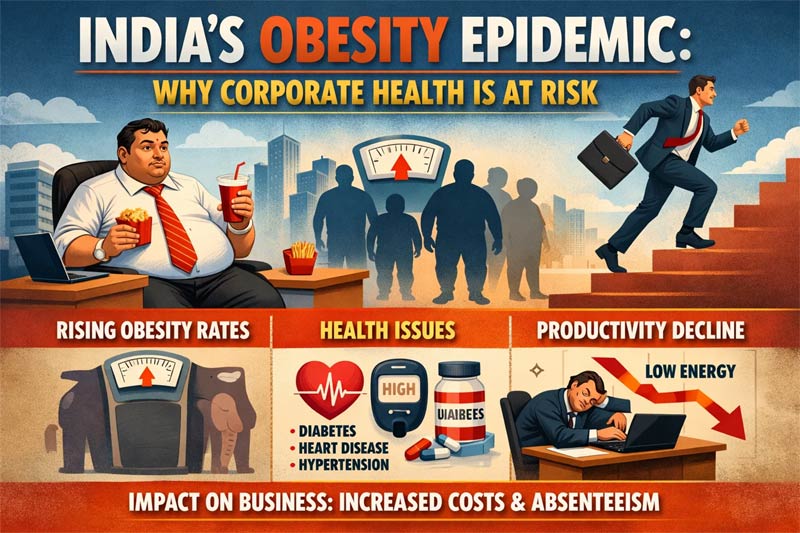
Rising Obesity Rates Among India’s Working Population
- High BMI Range A study conducted by Truworth Wellness, featuring approximately 1800 employees in the corporate sector, showed the overall health of the Indian workforce [4]. The findings of this study revealed a sharp decline in the healthy range of BMI every year.
- Decline in Healthy BMI About 38.83% of corporate employees were within the healthy BMI category, and it rose to 44.11% in 2023.
- Percentage of Obesity The overall percentage of obesity among employees is close to 50%, which indicates a potential risk faced by the corporate workforce of our country. Even though the percentage of obese individuals also declined from 38.21% to 35.69% between 2022 and 2023, it is evident that about 1/3rd of corporate employees in India have a higher BMI.
- Chronic Disease Risk These figures indicate that the Indian corporate workforce is at a higher risk of developing diabetes, high cholesterol, and heart diseases, contributed by sedentary lifestyles.
- Hypercholesterolemia Risk About 14.92% of the workforce also has Hypercholesterolemia, out of which 61.2% are aged below 40. Of this, around 2.7% are females and 17.3% were males.
- Diabetes and Heart Issues Truworth Wellness report also showed that when compared to female counterparts, males were three times more prone to develop diabetes, as many had high HbA1c levels, making them susceptible to cardiovascular issues.
- Gender-based Analysis Also, there was an immense difference in the rate of obesity among genders, as around 733 females were overweight and 1203 males were obese. Such gender-based obesity differences were mostly due to life and work imbalances and poor lifestyle.
- Young Workforce Among people aged less than 25, about 58% were considered healthy, which again took a dip in 2023 to 57.96%. However, the overweight percentage of the young workforce was at 46.57%. With age, they are also at risk of developing heart ailments.
Workplace Lifestyle Factors Driving Obesity in Corporate India
- Sedentary Jobs Most of the corporate sector and IT sector offer desk jobs, which require their workforce to sit and work for at least 10 hours per day on average. It causes a slower metabolism rate and physical inactivity, which are key contributors to the accumulation of stubborn fat [5].
- Work-related Stress The Indian corporate workforce is burdened with tight deadlines, longer working hours, job insecurity, and high targets, which causes chronic stress[6]. This, in turn, leads to high cortisol levels, causing them to develop unhealthy stress coping habits like drinking alcohol or smoking, binge eating, and more.
- Poor Food Options Most of the cafeterias in corporate offices serve junk foods as snacks that have fewer nutrients, high sugar and fat, and high calories. The availability of healthy food choices is very limited in office canteens.
- Unhealthy Diet With long working hours, the Indian corporate workforce is forced to order food from outside, as there is not enough time to prepare food at home. They tend to eat fast foods, processed foods, and junk foods along with sugar-loaded drinks, which are obesity inducers [7]. The young workforce often tries to skip meals, which can affect their metabolic activities.
- No Physical Activity Most Indian workplaces lack physical activity facilities like an indoor game area, a yoga corner, or a gym. When working hours are longer, employees don’t have time to exercise regularly [8].
- Irregular Sleeping Patterns Erratic work shifts and excess screen time can disrupt the sleep cycle of employees, causing sleep apnea. Lack of sleep, coupled with high BMI, affects hormone levels, induces hunger, and leads to overeating [9].
Business Impact of Obesity: Productivity Loss, Absenteeism, and Burnout
Obesity has become a critical workplace challenge, as corporations require their employees to stay mentally alert and have the stamina to perform tasks effectively. However, obesity affects businesses in the following ways.
Productivity Loss
Obesity directly affects the workforce’s performance and functional ability. The workplace becomes slower due to low stamina and energy levels. They also experience fatigue due to metabolic issues and reduced sleep hours. It also affects their mental clarity, creativity, decision-making, and concentration, which would affect work output. Health issues like chronic back pain, joint issues, and breathlessness caused by obesity will affect productivity levels.
Absenteeism
Obesity causes several health issues like diabetes, respiratory issues, hypertension, and heart ailments, making employees apply for more sick leaves. They might have to make frequent doctor appointments and undergo various check-ups, leading to absenteeism. Frequent employee absences will affect workflow and increase others’ workload.
Burnout and Mental Stress
Obesity is often associated with psychological strain and causes employee burnout. Obese people would be conscious of their body image and have low self-esteem, which might cause emotional stress. They might have chronic fatigue due to sleep disturbances, which can reduce self-motivation and impair performance.
Long-Term Health Risks of Obesity for India’s Corporate Workforce
- Cardiovascular Conditions Obesity can trigger hypertension, elevate cholesterol levels, and cause plaque deposits in blood vessels. Such activities can cause coronary heart disease, heart attacks, and even stroke, which are life-threatening and affect workplace productivity.
- Type 2 Diabetes Accumulation of too much body fat lowers insulin sensitivity, which leads to high blood sugar levels, causing type 2 diabetes. High blood glucose levels can also disrupt metabolic activities and affect heart, kidney, nerve, and eye health.
- High Blood Pressure Obesity will increase your blood pressure levels significantly, which, if not treated, will cause heart and kidney issues and might also cause stroke.
- Musculoskeletal Issues Spending up to 10 hours on desk jobs can put excess strain on your back and neck. Prolonged hours of sitting and obesity will lead to musculoskeletal issues, spinal problems, and osteoarthritis in the long run.
- Fatty Liver The overweight workforce is now facing the risk of developing NAFLD or non-alcoholic fatty liver disease owing to poor diet choices and an inactive lifestyle.
Corporate Wellness and Obesity Management Solutions in India
Businesses must opt for obesity management solutions and corporate wellness sessions to help their workforce remain highly productive and healthy. Corporate India is facing a steep rise in lifestyle diseases, higher healthcare expenses, and insurance claims, leading to productivity issues, absenteeism, and burnout. Kolors Healthcare is a well-known health and wellness specialist centre in India, specialising in personalised obesity, weight-loss, and lifestyle solutions for corporate professionals. Corporations can avail of their inch-loss and weight-loss programs, following holistic, non-surgical approaches to address workforce obesity. Employees can benefit from nutrition and dietary guidance, along with tailored diet plans to support better weight management.
Reference Links
- Daphne Clarance, Manisha Pandey: New Delhi – https://www.indiatoday.in
- NCD Risk Factor Collaboration. Worldwide trends in underweight and obesity from 1990 to 2022: a pooled analysis of 3663 population-representative studies with 222 million children, adolescents, and adults. The Lancet 2024. 16;403(10431):1027-1050. doi: 10.1016/S0140-6736(23)02750-2 – https://www.who.int/news-room/fact-sheets/detail/obesity-and-overweight
- Global Burden of Disease Collaborative Network. Global Burden of Disease Study 2021. Results. Institute for Health Metrics and Evaluation. 2024 (https://vizhub.healthdata.org/gbd-results/). – https://www.who.int/news-room/fact-sheets/detail/diabetes
- Tony Blair Institute for Global Change – https://institute.global/insights/public-services/building-on-success-to-secure-indias-future-health
- Ehteshamuddin, Mohammad & Gupta, Vijayendra. (2020). Occupational hazards and obesity in India-a public health menaces. 10.25215/0801.012. – https://www.researchgate.net/publication/352090649
- Somdutta Barua & Nandita Saikia – https://link.springer.com/article/10.1186/s12889-022-14531-9
- Banerjee P, Reddy GB, Panda H, Angadi KK, Reddy T, Gavaravarapu SM. Diets, Lifestyles and Metabolic Risk Factors among Corporate Information Technology (IT) Employees in South India. Nutrients. 2023 Jul 31;15(15):3404. doi: 10.3390/nu15153404. PMID: 37571341; PMCID: PMC10421222. – https://pmc.ncbi.nlm.nih.gov/articles/PMC10421222/
- National Heart, Lung, and Blood – https://www.nhlbi.nih.gov/health/overweight-and-obesity/causes
- National Heart, Lung, and Blood – https://www.nhlbi.nih.gov/health/overweight-and-obesity/causes