Protein is one of the highly discussed topics, especially among the vegetarian and vegan fitness circles. Most of you might even wonder whether vegetarian diets will be able to fulfil your needs for muscle-building and weight loss while offering enough energy-sustaining nutrients that only non-vegetarian foods can deliver. Thankfully, the truth is that a vegetarian or vegan diet can not only fulfil but even surpass your body’s nutrient requirements with specific foods that are dense with nutrients.
From versatile soya to filling legumes, there are several reasons to dig into your vegetarian food plate to fuel up your workout sessions and enhance overall body health. Whether you are a lifelong vegetarian, a new vegan, or wish to cut down on meat sources, it is essential to learn more about key protein sources to meet your body’s nutritional goals and cater to diverse taste needs. Keep reading to understand more about the high-protein vegetarian foods that are packed with vitamins, minerals, and fiber, making them an apt choice for muscle building [1].
What Are High-Protein Vegetarian Foods
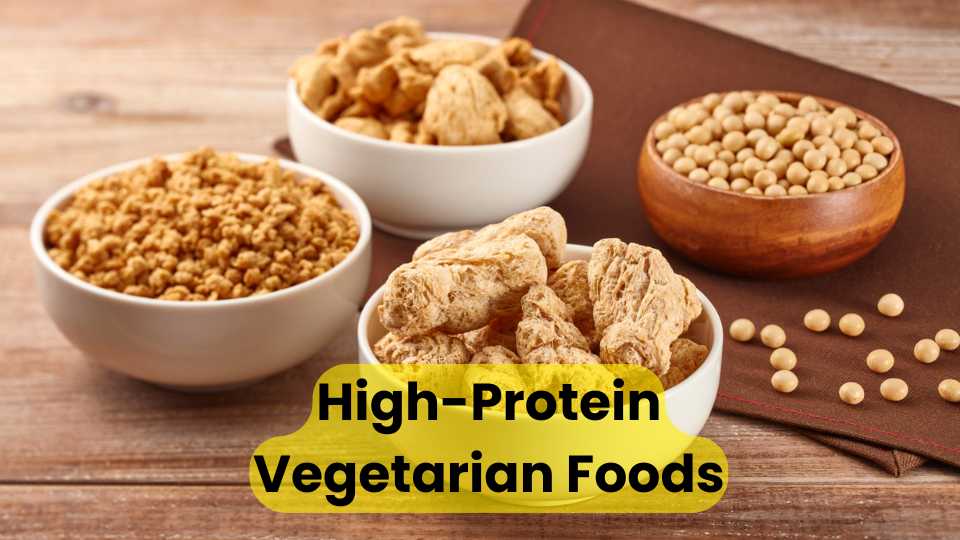
Vegetarian foods loaded with protein are pure plant-derived sources and will not contain any traces of meat, poultry, or fish, but can still provide enough protein essential for your muscles to grow and develop. Though very filling and satiating, these foods can help with weight loss while helping your body to produce essential hormones and enzymes, aid in growth and tissue repair, and enhance immunity [2]. Proteins contain amino acids [3], which are referred to as your body’s building blocks, as they help repair and build muscles, strengthen the immune system, and keep you full and satisfied [4]. Ensure your diet contains the following high-protein vegetarian food groups to fulfil your fitness goals:
- Legumes like peas, lentils, and beans are rich in nutrients and form an integral part of a vegetarian diet.
- Foods that contain soy as a major ingredient, like soy milk, tofu, edamame, and tempeh, make it an excellent muscle-building food. These foods are great at absorbing flavours and can adapt to any recipe.
- Nutrient-rich nuts are ideal sources of protein, micronutrients, and healthy fats, and are perfect as a topping or snacks.
- Whole grains, such as quinoa, are not just carbohydrates but are abundant in protein, making them an excellent choice for a hearty meal promoting satiety [5].
- Vegetables like broccoli, Brussels sprouts, and spinach are also good sources of protein that aid in detoxification, enhance circulation, and contain a good amount of fiber [6].
How Much Protein Do Vegetarians Need Per Day
The Journal of Nutrition study held in 2023 showed that diverse vegetarian foods were able to fulfil RDA requirements [7]. As a vegetarian, you might need about 0.8 grams per kg of your total body weight per day. However, if you are an active individual or an athlete, you might require more protein and can take up to 1.2 to 2 grams per kg. To meet your daily protein requirements, focusing on different vegetarian plant-based sources like nuts, soy products, lentils, and beans, and consuming them every day, will help in better absorption. For instance, if your body weight is 68 g, your protein intake should be 54 grams (0.8 X 68).
Best High-Protein Vegetarian Foods for a Daily Diet
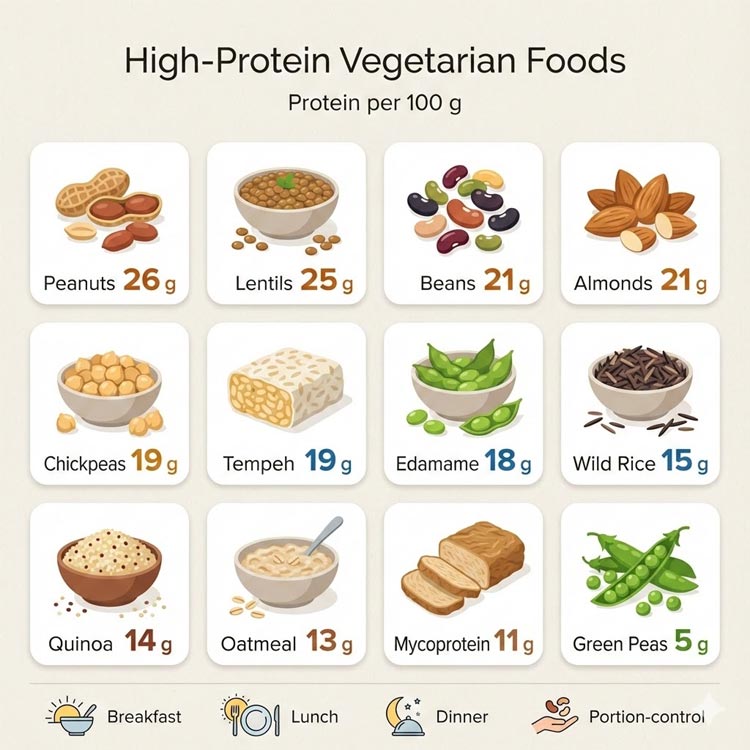
| Rank | Food | Protein (g) | Calories (kcal) | Best Time to Eat |
|---|---|---|---|---|
| 1 | Peanuts | 26 g | 567 | Snack (small portions) |
| 2 | Lentils | 25 g | 116 | Lunch / Dinner |
| 3 | Beans (Mixed) | 21 g | 127 | Lunch / Dinner |
| 4 | Almonds | 21 g | 579 | Snack |
| 5 | Chickpeas | 19 g | 164 | Lunch / Dinner |
| 6 | Tempeh | 19 g | 193 | Lunch / Dinner |
| 7 | Edamame | 18 g | 121 | Snack / Lunch |
| 8 | Wild Rice | 15 g | 101 | Lunch |
| 9 | Quinoa | 14 g | 120 | Breakfast / Lunch |
| 10 | Oatmeal | 13 g | 389 | Breakfast |
| 11 | Mycoprotein | 11 g | 85 | Lunch / Dinner |
| 12 | Green Peas | 5 g | 81 | Lunch |
If you thought that vegetarian foods can be bland, the following list of high-protein vegetarian foods will prove you otherwise with their versatility in cooking and solid flavours.
1. Chickpeas – The Protein Powerhouse
This versatile food is a low-carb and protein-dense vegetarian food, making it an essential choice for bodybuilders, weight loss, and growing muscles [8]. Taking a cup of cooked channa or chickpea would give you about 8 grams of protein every day. Adding chickpeas to your diet every day will help in lowering blood pressure, cutting down belly fat, and regulating blood sugar levels.
2. Edamame – The Soybean Wonder
This vegetarian food item is a soybean preparation that has found its way to this list for its high protein content. Consuming one bowl of edamame measuring 100 grams will provide your body with 11.5 grams of protein. The protein found in this vegetarian food contains 9 amino acids. Edamame also has fiber, folate, and vitamin K to support overall body health.
3. Wild Rice – Perfect Protein Source
When compared to white rice, including wild rice in the diet is beneficial as it has bran attached to it. This unpolished rice is a potent source of minerals, vitamins, fiber, and protein. A serving of cooked wild rice will give you protein worth 4 gm, making it an essential addition to the list of high-protein vegetarian foods.
4. Peanuts – Protein Abundant Legume
Eating 100 grams of peanuts will help you get 25.8 g of protein. Peanuts are a perfect addition to your vegetarian diet and can be used as toppings for salad, as a snack, or as a smoothie. Peanuts are an abundant source of fiber and healthy fats.
5. Lentils – The Gut-friendly Protein
Adding 100 gm of cooked lentils to your meal plate every day will help your body by providing protein worth 9 gm. This low-carb and high-protein food helps increase good gut bacteria and enhances colon health [9]. Eating lentils regularly would also help alleviate diabetes and heart disease risks.
6. Beans – The Friendly Food
Don’t be fooled by the tiny size of this vegetarian food. Get 9 gm of protein from a cup of boiled beans. Keep high cholesterol and blood sugar spikes at bay by consuming 100 gm of beans each day [10].
7. Almonds – Nutty Protein Delight
It is one of the protein-rich foods that can keep you full and meet your body’s nutritional needs. Almonds are muscle-building foods that are loaded with monounsaturated fats and can protect your heart against diseases. One 100 gm cup of almonds can give you about 21 g of protein.
8. Quinoa – Gluten-free Super Food
This supergrain is one of the top vegetarian foods loaded with protein. This gluten-free food has 8 gms of protein per cup of 185 g. It has low calories and keeps you feeling fuller for longer hours [11]. Quinoa also has a good amount of iron, magnesium, zinc, and folate.
9. Mycoprotein – A Tasty Protein
You can enjoy your favourite foods like burgers, fillets, and cutlets without any guilt when you spice them up with mycoprotein. About 100 g of this fungus type is loaded with 6 gms of fiber and 16 gms of protein. It is a non-animal protein source that can enhance your high-protein vegetarian diet.
10. Green Peas – The Tiny Delight
Including green peas every day will help you build muscles faster and keep you fuller for longer hours. Eating 100 g of boiled peas will help your body with 6.6 g of protein, along with a good amount of vitamins K and C, manganese, folate, thiamine, and fiber.
11. Tempeh – The Fermented Protein
This dish is prepared by fermenting soybeans and is an excellent source of protein. A serving of tempeh (100 g) has around 19 g of protein, enhances gut health, and meets your low-calorie requirements. This high-protein food also contains a good amount of amino acids, making it a compelling everyday food.
12. Oatmeal – The Weight Loss Companion
This vegetarian food is packed with fibre and protein, making it a perfect weight loss meal [12]. Eating 100 gm of oatmeal every morning as breakfast will help you get 10.1 g and 13.5 g of protein.
Tips to Increase Protein Intake
- Include protein-rich food items in each meal, like hemp seeds and chia seeds, along with oatmeal or smoothies.
- Ensure your lunch or dinner consists of a serving of lentils, tofu, tempeh, beans, etc in your rice bowls and salads.
- Include nut butters and toppings with cashews, peanuts, and almonds.
- Switch to high protein sources like quinoa, faro, amaranth, oats, or buckwheat in place of rice.
Reference
- Ribeiro AS, Nunes JP, Schoenfeld BJ. Should Competitive Bodybuilders Ingest More Protein than Current Evidence-Based Recommendations? Sports Med. 2019 Oct;49(10):1481-1485. doi: 10.1007/s40279-019-01111-y. PMID: 31028659. – https://pubmed.ncbi.nlm.nih.gov/31028659/
- From the Department of Nutrition and Exercise Physiology, School of Medicine, University of Missouri; Columbia, MO (HJL); the Sansom Institute for Health Research, School of Pharmacy and Medical Sciences (PMC) and School of Population Health (TPW), University of South Australia, Adelaide, Australia – https://www.sciencedirect.com/science/article/pii/S0002916523274274
- Mariotti F, Gardner CD. Dietary Protein and Amino Acids in Vegetarian Diets-A Review. Nutrients. 2019 Nov 4;11(11):2661. doi: 10.3390/nu11112661. PMID: 31690027; PMCID: PMC6893534. – https://pmc.ncbi.nlm.nih.gov/articles/PMC6893534/
- Shen Y, Levin A, Kamada A, Toprakcioglu Z, Rodriguez-Garcia M, Xu Y, Knowles TPJ. From Protein Building Blocks to Functional Materials. ACS Nano. 2021 Apr 27;15(4):5819-5837. doi: 10.1021/acsnano.0c08510. Epub 2021 Mar 24. PMID: 33760579; PMCID: PMC8155333. – https://pmc.ncbi.nlm.nih.gov/articles/PMC8155333/
- Douglas Paddon-Jones: The University of Texas Medical Branch at Galveston, Galveston, United States – https://www.sciencedirect.com/science/article/pii/S0002916523236643
- Langyan S, Yadava P, Khan FN, Dar ZA, Singh R, Kumar A. Sustaining Protein Nutrition Through Plant-Based Foods. Front Nutr. 2022 Jan 18;8:772573. doi: 10.3389/fnut.2021.772573. PMID: 35118103; PMCID: PMC8804093. – https://pmc.ncbi.nlm.nih.gov/articles/PMC8804093/
- Maryann R Rolands: Faculty of Biology and Medicine, University of Lausanne, Lausanne, Switzerland – https://www.sciencedirect.com/science/article/pii/S0022316624004504
- Yang Y, Zhou L, Gu Y, Zhang Y, Tang J, Li F, Shang W, Jiang B, Yue X, Chen M. Dietary chickpeas reverse visceral adiposity, dyslipidaemia and insulin resistance in rats induced by a chronic high-fat diet. Br J Nutr. 2007 Oct;98(4):720-6. doi: 10.1017/S0007114507750870. Epub 2007 Aug 1. PMID: 17666145. – https://pubmed.ncbi.nlm.nih.gov/17666145/
- Ganesan K, Xu B. Polyphenol-Rich Lentils and Their Health Promoting Effects. Int J Mol Sci. 2017 Nov 10;18(11):2390. doi: 10.3390/ijms18112390. PMID: 29125587; PMCID: PMC5713359. – https://pmc.ncbi.nlm.nih.gov/articles/PMC5713359/
- Vitale M, Giosuè A, Sieri S, Krogh V, Massimino E, Rivellese AA, Riccardi G, Vaccaro O, Masulli M. Legume Consumption and Blood Pressure Control in Individuals with Type 2 Diabetes and Hypertension: Cross-Sectional Findings from the TOSCA.IT Study. Nutrients. 2023 Jun 26;15(13):2895. doi: 10.3390/nu15132895. PMID: 37447221; PMCID: PMC10343530. – https://pmc.ncbi.nlm.nih.gov/articles/PMC10343530/
- Angeli V, Miguel Silva P, Crispim Massuela D, Khan MW, Hamar A, Khajehei F, Graeff-Hönninger S, Piatti C. Quinoa (Chenopodium quinoa Willd.): An Overview of the Potentials of the “Golden Grain” and Socio-Economic and Environmental Aspects of Its Cultivation and Marketization. Foods. 2020 Feb 19;9(2):216. doi: 10.3390/foods9020216. PMID: 32092899; PMCID: PMC7074363. – https://pmc.ncbi.nlm.nih.gov/articles/PMC7074363/
- Rasane P, Jha A, Sabikhi L, Kumar A, Unnikrishnan VS. Nutritional advantages of oats and opportunities for its processing as value added foods – a review. J Food Sci Technol. 2015 Feb;52(2):662-75. doi: 10.1007/s13197-013-1072-1. Epub 2013 Jun 25. PMID: 25694675; PMCID: PMC4325078. – https://pmc.ncbi.nlm.nih.gov/articles/PMC4325078/