
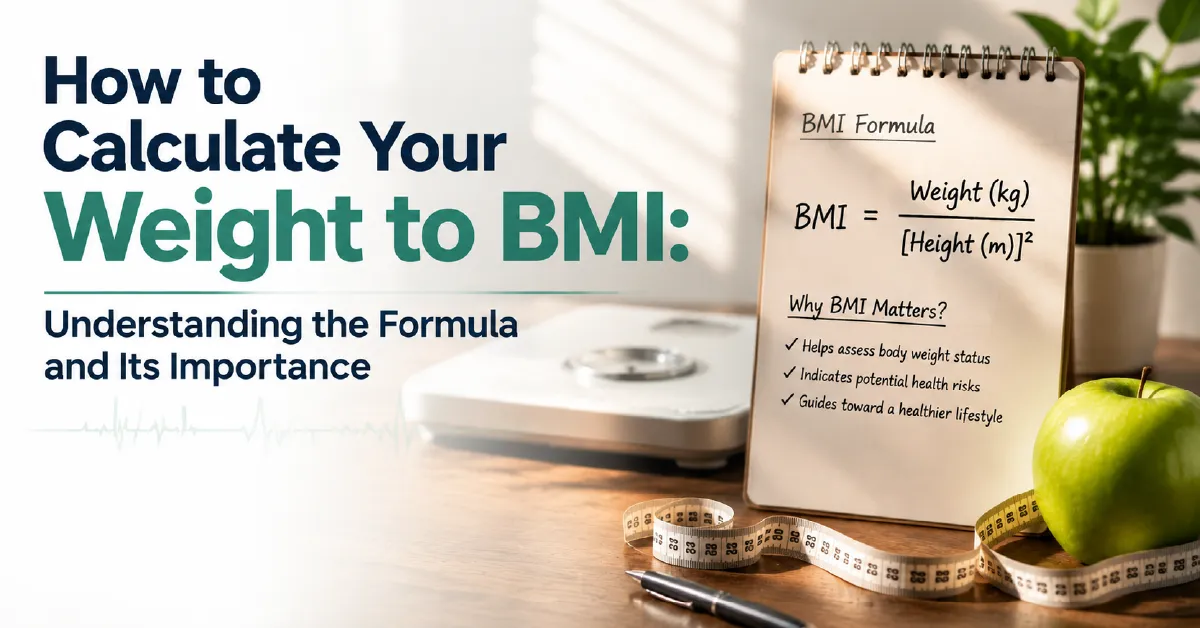
Did you consult a doctor or dietician recently? You would have come across the term BMI or Body Mass Index. They might have measured your body weight and height, entered the numbers, and given you a final score. But how was that number derived, and what does it mean? The health and wellness world depends on your BMI before suggesting treatment plans and lifestyle modifications. To calculate BMI, you don’t need any special tests or checkups, just a simple formula and calculation that compares your body weight to your height. Keep reading to learn how to make weight to BMI calculations, how this formula must be calculated using your height and body weight, and the significance of finding your BMI.
Understanding BMI
Also referred to as Body Mass Index, it indicates a numerical measurement that is useful for comparing an individual’s body weight with height[1]. BMI is mostly used as a preliminary screening standard to determine the weight category for adults. BMI has a straightforward basic concept that requires dividing your body weight by height. As height is used in BMI calculation, it offers better context than considering just body weight.
For instance, if an individual has a body weight of 80 Kg, it doesn’t convey whether it is on par with his or her height. An individual weighing 80 kg with a height of 180 cm will have a different BMI compared to one who is 160 cm tall[2]. It explains why it is essential to understand weight to BMI to evaluate body weight related to your height.
What is the formula for Weight to BMI?
For adults, the BMI will be calculated using the metric system’s formula:
BMI = Total Body Weight (in Kg) / Height (in mtr) x Height (in mtr)
Mathematically, the BMI formula can be written as:
BMI = kg/m²
Steps for Calculation of Weight to BMI
To calculate weight to BMI, you need not use any special device, as it is basic mathematics requiring simple calculation. Ensure you are using accurate details like your present body weight and height. Step on a digital weighing scale to measure your body weight in kilograms. Try to wear a dress made of light materials and remove your shoes to prevent extra weight from adding up. Then proceed to measure your height. If you are measuring your height, ensure it is recorded in meters. If it is in centimetres, convert it into meters by dividing it by 100. For instance, if your height is 168 cm, it can be converted to 1.68 m. As soon as you have obtained both height and weight measurements, multiply the height by two and divide that number by your body weight.
For example, if your body weight is 70 Kg with a height of 1.70 m.
BMI = kg/m²
BMI = 70 / (1.70 × 1.70)
BMI = 70 / 2.89
BMI ≈ 24.2
So, your BMI would be 24.2 approx.
Steps for Calculation of Weight to BMI in Inches and Pounds
If you are comfortable using inches or pounds when measuring your weight and height, you can use another version of the BMI formula. The formula to calculate weight to BMI in inches and pounds is:
BMI = Total Body Weight (in pounds) / Height (in inches) x Height (in inches) x 703
BMI = 154 / 68 x 68 x 703
BMI = 154 / 4624 x 703
BMI = 0.0333044 x 704
BMI = 23.41
When comparing the two BMI formulas, you will notice that the metric formula is much simpler, as it is calculated using meters and kilograms. Even if your measurements are recorded in inches and pounds, it is easy to convert them into cm and Kg before calculation.
What Do BMI Numbers Indicate?
For grownups, BMI is interpreted through the categories listed below:
- Obesity Category: BMI of 30 or more
- Overweight Category: BMI between 25 and 29.9
- Healthy Category: BMI between 18.5 and 24.9
- Underweight Category: BMI less than 18.5
Such BMI categories offer insight into the screening range generally instead of an accurate diagnosis. A high BMI range will indicate excess body fat, while a lower BMI shows that you are underweight. However, to determine whether an individual is fit or not, it must be considered along with factors like diet, lifestyle, waist circumference, medical history, and body composition.
Significance of Understanding Weight to BMI Connection
- It is important to learn the significance of weight to BMI to stay aware of your overall health status.
- Your BMI score serves as the initial checkpoint during the evaluation of obesity-related health concerns[3].
- A high BMI score shows that you are at a higher risk of developing chronic health issues like hypertension, type 2 diabetes, and heart conditions[4].
- But your BMI alone cannot help determine which specific type of chronic illness you will develop in the future.
- When your BMI is more than the recommended healthy range, it is essential to seek expert medical guidance to get a weight loss treatment plan or calorie-restricting diet.
- Checking the weight to BMI score will motivate you to alter your lifestyle and get back in shape to reduce body weight.
Importance of Using weight to BMI Formula in the Medical Field
-
Ease of Use
One of the major advantages of using weight to BMI formula in the medical field is that it is simple to use. It can be calculated with just two parameters, such as a person’s height and weight, which are easily obtained in a clinic. As the BMI formula is easy to use, it is considered a practical solution that can help medical professionals assess and evaluate the category of the patient’s weight condition[5].
-
Standardized Method
BMI formula serves as a standardized tool for assessing the patient’s body weight status based on his height. The score derived through BMI calculation helps with consistent comparison across varying settings and populations. Such standardization enables your doctor to track changing trends of body weight and enables implementation of health-based interventions[6].
-
Early Screening
BMI is considered an effective screening tool as it helps identify those patients who are at a higher risk of developing obesity-related chronic health issues. It helps people change their lifestyles and switch to mindful eating to avert chronic issues like diabetes, hypertension, and cardiovascular conditions[7]. Identifying the onset of such weight-related illnesses will help seek immediate medical intervention and professional evaluation to enhance patient outcomes.
-
Low-Cost Assessment
Hospitals and clinics rely on using weight to BMI formula to assess the weight status of their patients, as it has a pretty simple calculation. It doesn’t demand high-end equipment or rigorous training, and can be accessed within a clinical facility with limited resources.
Significance of Weight to BMI Formula for Patients
- Early Detection of Onset of Diseases: With the weight to BMI formula, patients would be able to notice the red flag and seek professional intervention immediately to avoid obesity-related diseases. By finding one’s BMI score, risks like developing cardiovascular conditions, high blood pressure, and type 2 diabetes can be detected early[8].
- Personalized Intervention: Using the score of weight to BMI formula, you will be able to get a tailored treatment plan to reduce your body weight and stay healthy. The personalized plan will include changes in diet, lifestyle modifications, weight loss programs, and physical workouts. Such interventions will be helpful for obese patients to maintain a healthy weight range and prevent the onset of chronic illnesses.
- Track Progress: BMI offers a straightforward method to keep track of a patient’s progress across different time intervals. The score of weight to BMI formula will help understand whether a new diet or workout change is working or not. Based on the patient’s progress, the doctor would be able to record the improvements and make adjustments to the treatment plan for better results.
- Raises Awareness: Discussing the BMI score with the patients will help them stay aware about their present health status and body weight range while understanding its impact in the future. It will help the patients feel motivated to follow proactive steps to follow a modified lifestyle and gain long-term health benefits.
When to Consider Professional Guidance?
Your weight to BMI score indicates whether you are facing obesity by gaining excess body weight. In such cases, you might have to opt for professional guidance to understand its impact in the future. The health experts at Kolors Healthcare will make an assessment of your waist circumference, medical history, blood pressure, cholesterol, lifestyle, and blood glucose levels before creating a personalized weight management plan. Rather than staying focused on bringing down the numbers on the scale, your objective should be following sustainable habits that can work wonders for your health and body in the long run.
Reference Links:
- Ma, W.-Q., Sun, X.-J., Wang, Y., Han, X.-Q., Zhu, Y., and Liu, N.-F. (2018) Does body mass index truly affect mortality and cardiovascular outcomes in patients after coronary revascularization with percutaneous coronary intervention or coronary artery bypass graft? A systematic review and network meta-analysis. Obesity Reviews, 19: 1236–1247. https://onlinelibrary.wiley.com/doi/10.1111/obr.12713
- Nair, T. (2021, October 18). More than skin color: Ethnicity-specific BMI cutoffs for obesity based on type 2 diabetes risk in England. American College of Cardiology. https://www.acc.org/latest-in-cardiology/articles/2021/10/18/15/35/more-than-skin-color
- Afzal S, Tybjærg-Hansen A, Jensen GB, Nordestgaard BG. Change in Body Mass Index Associated With Lowest Mortality in Denmark, 1976-2013. https://jamanetwork.com/journals/jama/fullarticle/2520627
- Wang ZJ, Zhou YJ, Galper BZ, et al Association of body mass index with mortality and cardiovascular events for patients with coronary artery disease: a systematic review and meta-analysis. https://heart.bmj.com/content/101/20/1631
- National Heart, Lung, and Blood Institute. (1998). Clinical guidelines on the identification, evaluation, and treatment of overweight and obesity in adults: The evidence report (NIH Publication No. 98-4083). National Institutes of Health. https://www.nhlbi.nih.gov/files/docs/guidelines/ob_gdlns.pdf
- Centers for Disease Control and Prevention. (2011). Body mass index: Considerations for practitioners. U.S. Department of Health and Human Services. https://stacks.cdc.gov/pdfjs/web/viewer.html?file=https://stacks.cdc.gov/view/cdc/25368/cdc_25368_DS1.pdf
- National Institute of Diabetes and Digestive and Kidney Diseases. (2023, May). Health risks of overweight & obesity. National Institutes of Health. https://www.niddk.nih.gov/health-information/weight-management/adult-overweight-obesity/health-risks?dkrd=/health-information/weight-management/health-risks-overweight
- Neeland, I. J., Poirier, P., & Després, J.-P. (2018). Cardiovascular and metabolic heterogeneity of obesity: Clinical challenges and implications for management. Circulation, 137(13), 1391–1406. https://www.ahajournals.org/doi/10.1161/CIRCULATIONAHA.117.029617